

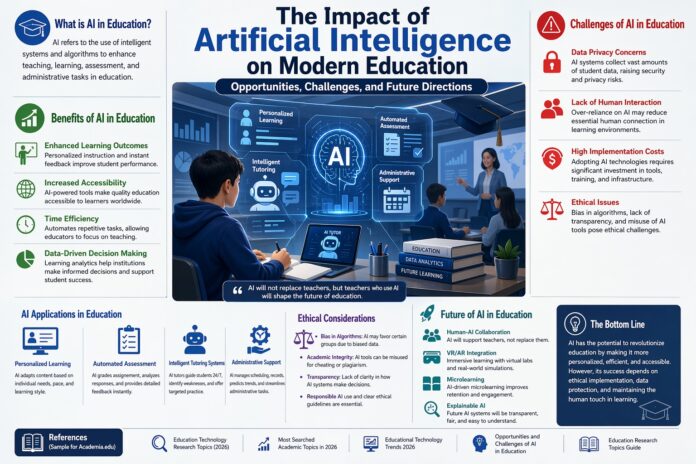
The Impact of Artificial Intelligence on Modern Education: Opportunities, Challenges, and Future Directions
Abstract
Artificial Intelligence (AI) has emerged as one of the most transformative technologies in the 21st century, significantly influencing multiple sectors, including education. This research paper explores the integration of AI in modern educational systems, focusing on its benefits, challenges, and long-term implications. The study investigates how AI-driven tools enhance personalized learning, improve student performance, and support educators in administrative and instructional tasks. At the same time, it critically examines ethical concerns, data privacy issues, and the potential risks associated with over-reliance on AI technologies. By analyzing recent trends and scholarly findings, this paper provides a comprehensive understanding of AI’s role in shaping the future of education.This is where professional services like Essay Writing Assignments become invaluable.
You may also read about:UK student visa financial requirements 2026
- Introduction
The rapid advancement of Artificial Intelligence (AI) has revolutionized traditional educational practices. Over the past decade, educational institutions have increasingly adopted AI-powered tools to improve teaching and learning processes. AI is no longer limited to automation; it now plays a crucial role in decision-making, content creation, and personalized learning experiences.
In 2026, AI in education has become one of the most researched topics globally due to its real-world impact and ethical implications . From intelligent tutoring systems to automated grading, AI technologies are transforming how students learn and how teachers teach.
This paper aims to explore the impact of AI on education by addressing the following research questions:
- How does AI enhance learning outcomes?
- What are the challenges associated with AI integration?
- What are the ethical implications of AI in education?
- Literature Review
Recent studies indicate that AI has significantly improved educational accessibility and efficiency. One of the key developments is AI-driven personalized learning, where algorithms adapt educational content based on individual student needs .
Research also highlights the growing use of AI tools such as chatbots and virtual tutors in classrooms. These tools provide instant feedback, helping students improve their understanding of complex topics.
Additionally, studies on AI in education reveal both opportunities and challenges. While AI enhances learning experiences, concerns about academic integrity, accuracy, and bias remain significant .
Another important trend is the integration of learning analytics, which uses data to track student performance and predict outcomes. This helps educators identify struggling students and provide timely support.
- Methodology
This research adopts a qualitative approach, analyzing existing literature, academic articles, and case studies related to AI in education. Secondary data sources were used to examine trends, challenges, and outcomes associated with AI implementation.
The study focuses on three main areas:
- AI-powered learning tools
- Student performance and engagement
- Ethical and social implications
- AI Applications in Education
4.1 Personalized Learning
AI enables personalized learning by analyzing student behavior and adapting content accordingly. Unlike traditional classroom settings, AI systems provide customized learning paths for each student.
For example:
- Adaptive learning platforms adjust difficulty levels
- AI tutors provide real-time feedback
- Students learn at their own pace
This approach improves engagement and academic performance.
4.2 Automated Assessment
AI has simplified the assessment process by automating grading systems. Teachers can now evaluate assignments more efficiently, saving time and reducing bias.
Automated systems:
- Grade multiple-choice questions instantly
- Analyze written responses using natural language processing
- Provide detailed feedback to students
4.3 Intelligent Tutoring Systems
AI-powered tutoring systems simulate human teaching by guiding students through complex topics. These systems are available 24/7, making education more accessible.
They:
- Identify student weaknesses
- Provide targeted exercises
- Offer step-by-step explanations
4.4 Administrative Support
AI also assists in administrative tasks such as:
- Scheduling classes
- Managing student records
- Predicting enrollment trends
This allows educators to focus more on teaching rather than administrative duties.
For students who need reliable and professional support, Online Essay Writing Services UK remains a trusted choice.
- Benefits of AI in Education
5.1 Enhanced Learning Outcomes
AI improves learning efficiency by providing personalized instruction. Students receive immediate feedback, which helps them correct mistakes quickly.
5.2 Increased Accessibility
AI-powered platforms make education accessible to students worldwide, including those in remote areas. Online learning tools eliminate geographical barriers.
5.3 Time Efficiency
Teachers save time on repetitive tasks such as grading and attendance tracking, allowing them to focus on student interaction.
5.4 Data-Driven Decision Making
AI uses data analytics to improve teaching strategies and student outcomes. Institutions can make informed decisions based on real-time data.
- Challenges of AI in Education
Despite its advantages, AI presents several challenges.
6.1 Data Privacy Concerns
AI systems collect large amounts of student data, raising concerns about privacy and data security. Unauthorized access to this data can lead to serious consequences.
6.2 Lack of Human Interaction
Over-reliance on AI may reduce human interaction in classrooms, which is essential for emotional and social development.
6.3 High Implementation Costs
Implementing AI technologies requires significant financial investment, which may not be feasible for all institutions.
6.4 Ethical Issues
AI systems may exhibit bias due to flawed algorithms or biased data. Ensuring fairness and transparency is a major challenge.
- Ethical Considerations
Ethical concerns surrounding AI in education include:
- Bias in Algorithms: AI systems may favor certain groups over others
- Academic Integrity: AI tools can be misused for cheating
- Transparency: Lack of clarity in how AI systems make decisions
Researchers emphasize the need for responsible AI use and ethical guidelines to address these issues .
- Future of AI in Education
The future of education is closely linked to AI advancements. Emerging trends include:
8.1 Human-AI Collaboration
Rather than replacing teachers, AI will work alongside them to enhance teaching effectiveness.
8.2 Virtual and Augmented Reality
AI combined with VR/AR technologies will create immersive learning experiences, such as virtual labs and simulations .
8.3 Microlearning
AI-driven microlearning breaks content into smaller, manageable units, improving retention and engagement.
8.4 Explainable AI
Future AI systems will focus on transparency, allowing users to understand how decisions are made.
- Discussion
The integration of AI in education has both positive and negative implications. While AI enhances learning efficiency and accessibility, it also raises ethical and social concerns.
The key challenge lies in balancing technological innovation with human-centered education. Educators must ensure that AI complements, rather than replaces, traditional teaching methods.
- Conclusion
Artificial Intelligence is reshaping the educational landscape by introducing innovative teaching and learning methods. Its ability to personalize learning, automate tasks, and improve accessibility makes it a powerful tool in modern education.
However, the successful implementation of AI requires addressing challenges such as data privacy, ethical concerns, and high costs. Policymakers, educators, and researchers must work together to develop responsible AI systems that benefit all learners.
In conclusion, AI has the potential to revolutionize education, but its impact depends on how it is implemented and regulated.
References (sample for Academia.edu)
- Education Technology Research Topics (2026)
- Most Searched Academic Topics in 2026
- Educational Technology Trends 2026
- Opportunities and Challenges of AI in Education
- Education Research Topics Guide

