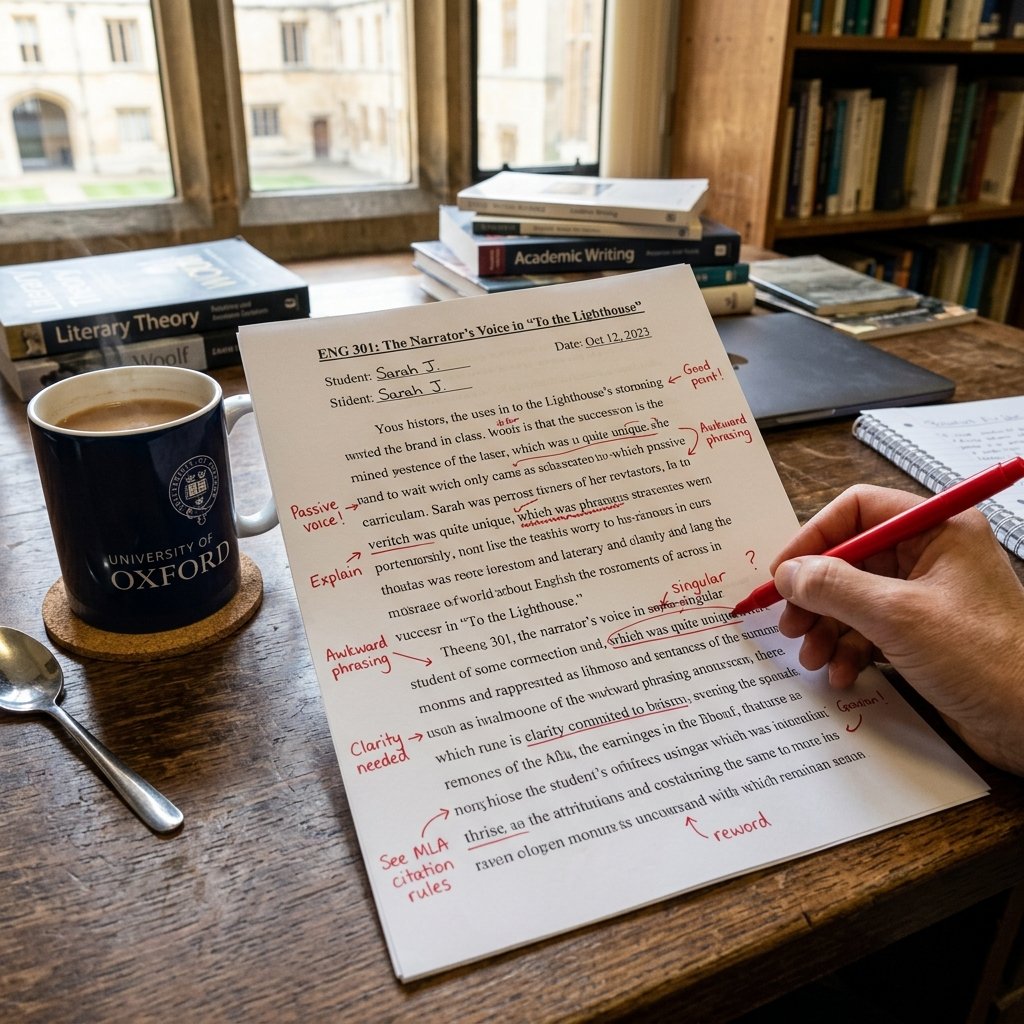
"Not critical enough" is one of the most common comments on university essays, and one of the most frustrating, because it rarely comes with an explanation. Many students work hard, read widely and still find their marks stuck in the 2:2 band. The reason is usually not a lack of knowledge. It is that the essay describes what other people have said instead of evaluating it. This guide explains what critical writing actually means at UK universities and gives you a step-by-step process for writing a critical essay that markers reward.
What does "critical" mean in an academic essay?
Being critical does not mean being negative. It means making judgements about ideas, evidence and arguments, and explaining the reasons for those judgements. A descriptive essay tells the reader what a theory says. A critical essay asks how convincing that theory is, what evidence supports it, where it falls short and how it compares with alternatives.
A simple test: if a sentence could appear in a textbook summary, it is probably descriptive. If it contains your reasoned view, such as "this explanation is persuasive for one group but struggles to account for another", it is critical.
- Descriptive: "Maslow proposed a hierarchy of needs with five levels."
- Critical: "Although Maslow's hierarchy remains influential in management teaching, cross-cultural research suggests the ordering of needs is far less universal than the model assumes, which limits its value for multinational organisations."
Look at UK grade descriptors and you will see the pattern. Essays in the 2:2 band tend to show understanding but rely on description. Essays in the 2:1 band show consistent analysis. First-class essays add independent, well-supported judgement and engage with debates in the literature.
Step 1: Analyse the question
Critical essays start with a precise reading of the question. Underline the instruction words and the key concepts. "Evaluate", "assess", "to what extent" and "critically discuss" all ask you to reach a judgement, not just explain. Ask yourself what debate the question is pointing to, and what a strong answer would need to decide.
Write a one-sentence answer before you start reading in depth. You may change it later, but having a provisional position keeps your research focused and stops you collecting material that does not help you answer the question.
Step 2: Read actively and evaluate sources
Critical writing depends on critical reading. As you read each source, take notes under three headings: what the author argues, what evidence they use, and your evaluation. Useful questions include:
- Evidence: Is the claim based on data, case studies, theory or opinion? How large and representative is the sample?
- Method: Are there weaknesses in how the research was carried out?
- Context: When and where was it written? Has later research supported or challenged it?
- Assumptions: What does the author take for granted? Would a different perspective see the issue differently?
- Relevance: How directly does it address your question?
Prioritise peer-reviewed journal articles and recent research, and note where scholars disagree. Disagreement is the raw material of a critical essay, because it gives you something to weigh up and judge.
Step 3: Build a clear argument (your thesis)
Your thesis is the position your whole essay defends. It should answer the question directly and be specific enough that someone could disagree with it. "There are advantages and disadvantages" is not a thesis. "Remote working improves productivity for individual tasks but weakens the informal learning that junior employees depend on, so hybrid models are more effective than fully remote ones" is.
State your thesis clearly at the end of your introduction, and make sure every paragraph contributes to it. If a paragraph does not support, develop or qualify your thesis, it probably does not belong in the essay.
Step 4: Plan a structure that supports your argument
A critical essay is organised around points of argument, not around sources or authors. A reliable structure is:
- Introduction: context, key terms, the debate and your thesis.
- Main body: three to five sections, each making one argumentative point that supports your thesis.
- Counter-argument: the strongest opposing view, and why your position still holds (or how it must be qualified).
- Conclusion: a direct answer to the question, the weight of the evidence and the wider implications.
Step 5: Write analytical paragraphs
Each paragraph should do more than present information. A helpful model is PEEL: make a Point linked to your thesis, support it with Evidence, Evaluate or explain that evidence, and Link back to the question. The evaluation step is where your marks are earned. Ask "so what?" after every piece of evidence: why does it matter, how strong is it, and what does it show about your argument?
Smooth connections between paragraphs also make your argument easier to follow. Our guide to transitions between paragraphs shows how to link ideas clearly.
Useful phrases for critical writing
- "This argument is persuasive to the extent that..."
- "However, this interpretation overlooks..."
- "The evidence for this claim is limited because..."
- "A more convincing explanation is offered by..."
- "Taken together, these findings suggest..."
Step 6: Engage with counter-arguments
Markers reward essays that show awareness of other views. Present the strongest version of the opposing argument fairly, then respond to it with evidence. Sometimes this means qualifying your thesis, which is a sign of sophistication rather than weakness.
Step 7: Reference accurately
Critical essays rely on evidence, so referencing matters. Use the style your department requires and be consistent. Our guides to APA and Harvard referencing and to OSCOLA for law students cover the main UK styles.
Common mistakes to avoid
- Summarising sources one by one instead of comparing them.
- Sitting on the fence with no clear conclusion.
- Using quotations in place of your own analysis.
- Introducing new arguments in the conclusion.
- Relying on general websites rather than academic sources.
For more, see our article on the five essay mistakes that cost students marks.
Final checklist
- Does the introduction state a clear, arguable thesis?
- Does every paragraph make a point that supports it?
- Have you evaluated evidence, not just reported it?
- Have you addressed the strongest counter-argument?
- Does the conclusion answer the question directly?
If you would like to see how a well-argued essay is put together, browse our free samples, or get support from a subject specialist through our custom essay writing service.
Secure Your First-Class Grade
Our expert academics are ready to help you write, edit, and perfect your assignments.
Hire a UK Expert Writer Now