

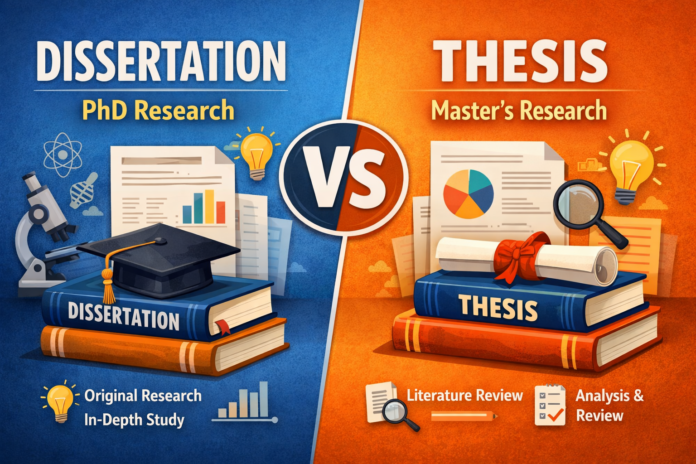
Understanding the difference between a dissertation vs thesis is essential for students pursuing higher education. These two academic terms are often used interchangeably, especially in different countries and educational systems, which creates confusion among students. While both are major research projects required for advanced degrees, they differ in purpose, structure, level of research, and academic expectations. Whether you are planning to pursue a master’s degree or a doctoral program, knowing the distinction between a thesis and a dissertation will help you prepare for the research journey ahead.
In this comprehensive guide, we will explore the key differences between a dissertation and a thesis, including their definitions, purposes, structures, and expectations across various education systems.
You may also read:Dissertation Writing samples .Complete Guide
What Is a Thesis?
A thesis is a research-based academic document that students typically write as part of a master’s degree program. It demonstrates a student’s ability to conduct independent research, analyze data, and present findings in a structured and scholarly manner.
The primary goal of a thesis is to show that the student understands the existing research in a particular field and can contribute new insights or interpretations. While the research may be original, it often builds upon existing studies rather than introducing a completely new theory.
A thesis allows students to develop critical thinking, analytical skills, and academic writing abilities, which are essential for advanced research or professional careers.
Key Characteristics of a Thesis
A thesis has several distinctive features that define its academic purpose.
Focus on Existing Research
Most theses involve reviewing existing literature and analyzing previously published work. Students evaluate theories, frameworks, and data from earlier research to support their argument or hypothesis.
Moderate Length
A typical master’s thesis ranges between 40,000 and 60,000 words, depending on the university and academic discipline.
Demonstrates Research Skills
The thesis demonstrates that a student can design a research project, collect or analyze data, and interpret the results logically.
Required for Master’s Degree
In many universities, completing a thesis is a mandatory requirement for obtaining a master’s degree.
What Is a Dissertation?
A dissertation is a much more extensive research project usually required for a doctoral degree (PhD). It represents original research that contributes new knowledge, theories, or insights to a specific academic field.
Unlike a thesis, which often reviews and interprets existing research, a dissertation requires students to develop a unique research question and produce findings that significantly advance the field.
A dissertation is considered one of the most important academic achievements in higher education, as it demonstrates a scholar’s expertise and ability to conduct independent, original research.
Key Characteristics of a Dissertation
A dissertation is more complex and demanding than a thesis.
Original Contribution to Knowledge
A doctoral dissertation must provide new insights, theories, or discoveries that expand the existing body of knowledge in a discipline.
Extensive Research
Students conducting dissertation research often spend several years gathering data, conducting experiments, or analyzing complex datasets.
Longer Document
A dissertation is usually 80,000 to 100,000 words or more, depending on the field of study.
Required for PhD Programs
Completing and defending a dissertation is typically required to earn a doctoral degree.
Dissertation vs Thesis: Main Differences
Although both documents involve academic research and writing, they differ in several important ways.
Purpose of Research
The primary difference between a thesis and a dissertation lies in their research objectives.
A thesis focuses on demonstrating that a student understands existing research and can analyze it effectively. It proves the student’s ability to conduct academic research.
A dissertation, on the other hand, requires students to produce original research that contributes new knowledge to their field.
Academic Level
Another major difference is the academic level at which these documents are required.
A thesis is usually written for a master’s degree, while a dissertation is required for a doctoral degree (PhD).
However, it is important to note that the terminology can vary between countries. For example, in the United Kingdom and many European countries, the term “dissertation” is often used for master’s research projects.
Research Depth
The depth of research also distinguishes a thesis from a dissertation.
A thesis generally involves analyzing existing literature and applying established research methods.
A dissertation involves deeper investigation, complex methodologies, and extensive original research.
Length and Scope
Because dissertations involve more advanced research, they are typically longer than theses.
A thesis might be around 40,000–60,000 words, while a dissertation can exceed 80,000–100,000 words.
Defense Process
Both theses and dissertations usually require a defense, where the student presents their research to a panel of academic experts.
However, dissertation defenses tend to be more rigorous because doctoral research must demonstrate a significant scholarly contribution.
Dissertation vs Thesis in Different Countries
The meaning of “thesis” and “dissertation” can change depending on the country.
United States
In the United States:
- Thesis = Master’s degree research project
- Dissertation = Doctoral (PhD) research project
This distinction is widely used in American universities.
United Kingdom
In the United Kingdom, the terminology is often reversed or used differently.
- Dissertation = Research project for bachelor’s or master’s degree
- Thesis = Research project for a PhD
This difference often confuses international students who study in UK universities.
Europe and Other Regions
In many European countries, the terminology may vary depending on the university. However, doctoral research is usually referred to as a doctoral thesis.
Understanding these differences is important for students applying to international universities.
Structure of a Thesis
Although the exact structure can vary by institution and discipline, most theses follow a similar format.
Introduction
The introduction provides an overview of the research topic, background information, research objectives, and the main research questions.
Literature Review
This section reviews existing studies related to the topic. It highlights previous research findings, theoretical frameworks, and gaps in the literature.
Methodology
The methodology explains how the research was conducted. It includes details about research design, data collection methods, sampling techniques, and analytical tools.
Results
This section presents the findings of the research, often using tables, graphs, or charts to explain the data.
Discussion
The discussion interprets the results and explains how they relate to the research question and previous studies.
Conclusion
The conclusion summarizes the key findings, discusses limitations, and suggests areas for future research.
Structure of a Dissertation
A dissertation generally follows a more detailed structure because of its complex research design.
Introduction
The introduction outlines the research problem, objectives, significance of the study, and the scope of the research.
Literature Review
The literature review in a dissertation is usually more extensive than in a thesis. It critically analyzes existing theories and research to establish the foundation for the study.
Research Methodology
This section describes the research design, data collection techniques, sampling methods, and analytical tools used in the study.
Data Analysis
The data analysis section explains how the collected data was processed and analyzed using statistical or qualitative methods.
Findings
This chapter presents the results obtained from the analysis.
Discussion
The discussion connects the findings with existing theories and explains their implications for the field.
Conclusion and Recommendations
The final section summarizes the study and suggests recommendations for future research or practical applications.
Similarities Between a Thesis and a Dissertation
Despite their differences, theses and dissertations share several similarities.
Academic Research
Both require extensive academic research and critical analysis.
Structured Format
Both follow a formal academic structure with sections such as introduction, literature review, methodology, results, and conclusion.
Supervision
Students typically complete their research under the guidance of an academic supervisor.
Oral Defense
In many universities, students must defend their work before a panel of experts.
How to Choose a Good Research Topic
Selecting a strong research topic is one of the most important steps when writing a thesis or dissertation.
Choose a Topic You Are Passionate About
Research projects can take months or even years to complete. Choosing a topic you genuinely enjoy will help maintain motivation.
Review Existing Literature
Before finalizing a topic, review existing research to identify gaps that your study can address.
Consider Research Feasibility
Make sure the topic is practical in terms of available resources, data, and time.
Consult Your Supervisor
Your academic supervisor can provide valuable guidance in refining your research idea.
Common Challenges Students Face
Writing a thesis or dissertation can be challenging. Many students face difficulties during the research and writing process.
Time Management
Balancing research, writing, and other academic responsibilities can be overwhelming.
Data Collection
Collecting reliable data can sometimes be difficult, especially in fields that require experiments or surveys.
Writer’s Block
Many students struggle with maintaining consistency and motivation while writing long academic documents.
Maintaining Academic Standards
Proper referencing, avoiding plagiarism, and maintaining academic integrity are essential requirements.
Tips for Writing a Successful Thesis or Dissertation
Students can improve their chances of success by following several important strategies.
Start Early
Beginning your research early allows more time for data collection, analysis, and revisions.
Create a Research Plan
Develop a clear research schedule with specific milestones and deadlines.
Stay Organized
Keep research notes, references, and data well organized to avoid confusion later.
Use Academic Sources
Always rely on credible academic journals, books, and scholarly databases.
Edit and Revise
Carefully proofread and revise your work to ensure clarity, coherence, and accuracy.
Final Thoughts
Understanding the difference between a dissertation and a thesis is essential for students pursuing higher education. While both involve extensive academic research and writing, they serve different purposes and are required at different stages of academic study.
A thesis typically demonstrates a master’s student’s ability to analyze and interpret existing research, while a dissertation requires doctoral students to produce original research that contributes new knowledge to their field.
Regardless of whether you are writing a thesis or a dissertation, the key to success lies in selecting a strong research topic, conducting thorough research, maintaining academic integrity, and staying committed to the writing process.
With careful planning, dedication, and guidance from academic mentors, students can successfully complete these major academic milestones and contribute meaningful insights to their chosen fields.

