

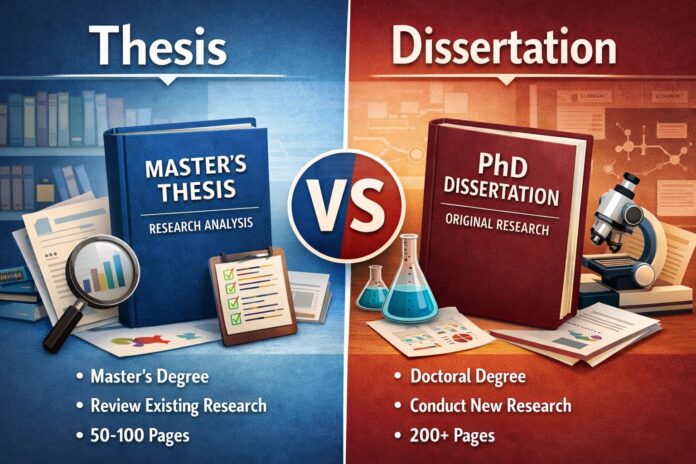
Understanding the distinctions between a PhD dissertation and a thesis is crucial for students planning to pursue advanced degrees. While the terms are often used interchangeably in casual conversation, they refer to distinct types of academic work with different purposes, scopes, and expectations. This guide explains the key differences and helps first-time researchers navigate their academic journey effectively.
What is a Thesis?
A thesis is a scholarly document submitted as part of a master’s degree program. It demonstrates a student’s understanding of the existing body of knowledge in their field and their ability to conduct independent research.
Purpose of a Thesis
The primary purpose of a thesis is to:
- Showcase the student’s ability to analyze existing research.
- Develop a critical understanding of a topic.
- Contribute new insights or perspectives to a particular academic field.
Unlike a dissertation, a thesis often focuses on proving a student’s knowledge and mastery of established theories rather than generating entirely original research.
Structure of a Thesis
A typical master’s thesis includes the following sections:
Introduction
- Outlines the research problem.
- Provides background and context.
- States the research objectives and questions.
Literature Review
- Discusses prior studies and key theories.
- Identifies gaps in existing research.
- Establishes the rationale for the study.
Methodology
- Describes the research design.
- Explains methods for data collection and analysis.
- Justifies the chosen methodology.
Results
- Presents the findings of the research.
- Often includes tables, charts, or graphs.
Discussion and Conclusion
- Interprets the results in the context of existing literature.
- Discusses implications and limitations.
- Suggests directions for future research.
What is a PhD Dissertation?
A PhD dissertation is a more comprehensive and in-depth research project required for the completion of a doctoral degree. Its main purpose is to make an original contribution to knowledge in a specific academic field.
Purpose of a Dissertation
The dissertation aims to:
- Present innovative research that advances the field.
- Demonstrate the student’s ability to conduct independent, rigorous research.
- Prepare the student for a career in academia, research, or specialized professional fields.
Structure of a Dissertation
A typical PhD dissertation includes these sections:
Introduction
- Presents the research problem in depth.
- Establishes the significance of the study.
- Outlines research objectives, hypotheses, and scope.
Literature Review
- Reviews and critically evaluates existing studies.
- Provides theoretical frameworks.
- Identifies research gaps and justifies the dissertation topic.
Methodology
- Explains research design, methods, and techniques.
- Includes detailed descriptions of data collection and analysis.
- Ensures reproducibility and academic rigor.
Results
- Presents comprehensive findings with extensive data analysis.
- May include multiple studies, experiments, or surveys.
Discussion
- Interprets results in the context of the field.
- Demonstrates original insights and theoretical contributions.
- Discusses broader implications for practice, policy, or theory.
Conclusion
- Summarizes the research contributions.
- Reflects on limitations and future research directions.
- Emphasizes the significance of the study for the academic community.
Key Differences Between Thesis and Dissertation
Although a thesis and dissertation share similarities as academic research projects, there are several fundamental differences.
1. Purpose
- Thesis: Designed to show mastery of existing knowledge.
- Dissertation: Designed to create new knowledge and contribute original research.
2. Degree Level
- Thesis: Required for master’s degrees.
- Dissertation: Required for doctoral (PhD) degrees.
3. Research Scope
- Thesis: Typically narrower in scope, focusing on analyzing and synthesizing existing studies.
- Dissertation: Broader and deeper, aiming to introduce new theories, models, or discoveries.
4. Length and Depth
- Thesis: Usually 50–100 pages, concise, and focused.
- Dissertation: Can exceed 200 pages, with extensive literature review, methodology, and results.
5. Originality
- Thesis: May involve some original research, but primarily reviews and applies existing knowledge.
- Dissertation: Must involve original research that advances the field.
6. Defense Process
- Thesis: Often defended before a committee of department faculty.
- Dissertation: Defended in front of a doctoral committee and sometimes external examiners, with more rigorous scrutiny.
7. Time Required
- Thesis: Usually completed within 1–2 years as part of a master’s program.
- Dissertation: May take 3–7 years depending on the research complexity and field of study.
8. Outcome
- Thesis: Confirms readiness for professional practice or advanced study.
- Dissertation: Establishes the student as a research expert and can lead to publications in academic journals.
Differences in Research Approach
Understanding the research approach is critical when distinguishing between a thesis and a dissertation.
Thesis Research Approach
- Focused on exploratory or analytical work.
- Often involves reviewing existing data.
- Emphasizes the application of theories rather than testing new hypotheses.
Dissertation Research Approach
- Involves original experiments, data collection, and testing hypotheses.
- Often requires multi-phase studies, longitudinal research, or mixed-method approaches.
- Emphasizes contribution to knowledge rather than merely demonstrating understanding.
Writing Style Differences
The writing style for a thesis versus a dissertation also differs.
Thesis Writing Style
- Clear, concise, and focused on analysis and synthesis.
- Primarily demonstrates comprehension of the subject.
- Often less formal in academic tone compared to a dissertation.
Dissertation Writing Style
- Academic, formal, and highly detailed.
- Includes extensive citations, tables, figures, and appendices.
- Prioritizes logical argumentation and evidence-based conclusions.
Choosing Between a Thesis and Dissertation
Whether you pursue a thesis or a dissertation depends on your academic goals and the degree program requirements.
Factors to Consider
- Degree Program
- Master’s programs generally require a thesis.
- PhD programs require a dissertation.
- Career Goals
- A thesis may be sufficient for professional practice or industry jobs.
- A dissertation is essential for a research career or academia.
- Research Interests
- Consider the scope of your interest: exploring existing research (thesis) vs creating new knowledge (dissertation).
- Time Commitment
- Evaluate the time available for research and writing.
- Dissertations require longer planning and execution.
Common Misconceptions
Several misconceptions exist regarding theses and dissertations.
Misconception 1: They Are the Same
While the terms are sometimes used interchangeably in North America, they are not the same. The dissertation is more advanced and requires original research, while a thesis mainly synthesizes existing knowledge.
Misconception 2: A Dissertation Is Just a Longer Thesis
Length is not the main differentiator. The purpose and originality of research set a dissertation apart from a thesis.
Misconception 3: Only PhD Students Publish Dissertations
While dissertations are research-focused, master’s students can also publish thesis work, particularly if it contains novel findings.
Tips for Writing a Thesis
Writing a thesis requires planning, critical thinking, and effective research.
Step 1: Choose a Relevant Topic
- Select a topic aligned with your field of study.
- Ensure it is feasible and researchable.
Step 2: Conduct a Literature Review
- Review existing studies.
- Identify gaps and unresolved questions.
- Formulate research objectives.
Step 3: Plan Your Methodology
- Decide on qualitative, quantitative, or mixed methods.
- Justify your approach.
Step 4: Write and Revise
- Draft each section systematically.
- Edit for clarity, coherence, and style.
Step 5: Seek Feedback
- Consult your advisor.
- Revise based on feedback before submission.
Tips for Writing a Dissertation
Dissertation writing is more complex and requires rigorous planning.
Step 1: Define Original Research
- Identify a unique research problem.
- Ensure the study can contribute new knowledge.
Step 2: Extensive Literature Review
- Conduct a comprehensive review of all relevant studies.
- Use this to justify your research and identify theoretical frameworks.
Step 3: Develop a Detailed Methodology
- Explain research design, sampling, instruments, and procedures.
- Ensure academic rigor and reproducibility.
Step 4: Collect and Analyze Data
- Gather primary or secondary data.
- Use advanced analysis techniques.
- Maintain accuracy and transparency.
Step 5: Discuss Findings
- Interpret results in relation to existing literature.
- Highlight contributions and implications.
Step 6: Conclude and Suggest Future Research
- Summarize findings.
- Discuss limitations.
- Propose avenues for further study.
Conclusion
Understanding the difference between a PhD dissertation and a thesis is essential for students entering advanced academic programs. While both involve extensive research and writing, a thesis primarily demonstrates mastery of existing knowledge, whereas a dissertation contributes original research to the academic community. By recognizing these differences, students can set realistic expectations, choose the appropriate path, and achieve academic success.

